Fattoria di Mato Rujo
Senza sangueFattoria di Mato Rujo is the remote farmhouse at the center of the novel’s foundational atrocity: a place first defined by its isolation and its concealed refuge, then destroyed by violence while Nina remains hidden beneath it. The contrast between the house’s underground shelter and its burning ruins makes the farm both a literal site of survival and the enduring landscape of a child’s trauma.
Setting and Approach
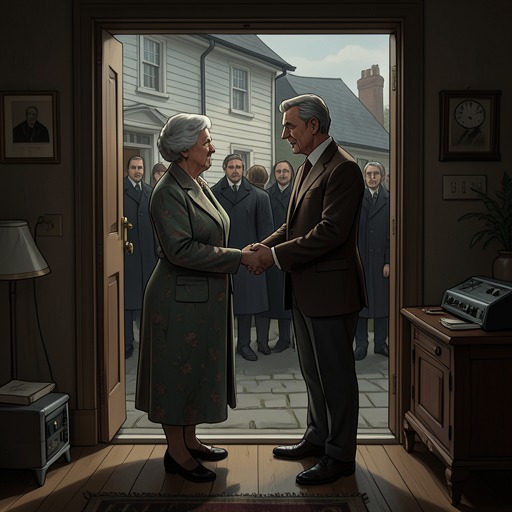
In the countryside, the old farmhouse stands out as the only mark on an emptied plain, its dark outline cut against the evening light. Its isolation is practical as well as visual: the road is dry and deeply rutted, and Manuel Roca sees a column of dust before he hears the engine of a Mercedes. In a region where, as he knows, people no longer have cars, the vehicle’s arrival announces an intrusion before its occupants come into view.
The four men approach in the Mercedes, and Roca watches it appear in the distance and disappear behind a row of oaks. He then turns away from the window and back toward his family. The sequence gives the farmhouse a fragile interval between warning and attack: the men are not yet at the door, but Roca already understands enough to act. The surrounding fields and trees offer little protection; the house, alone in the landscape, must provide whatever refuge is possible.
The Hidden Refuge
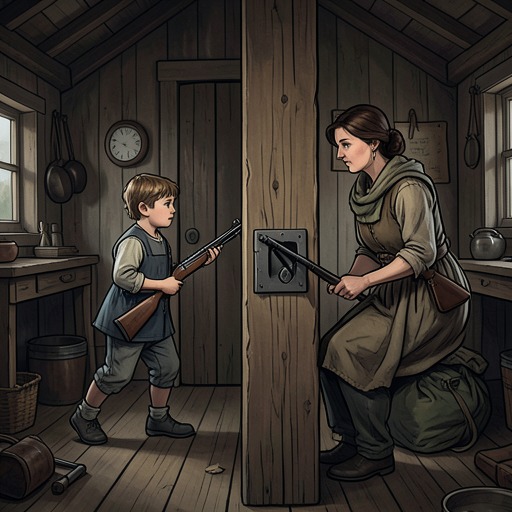
Before the visitors arrive, Roca moves baskets of fruit to uncover a concealed trapdoor. Beneath it is not a furnished room but a large hole dug into the earth, compared to an animal’s den. He instructs Nina to hide there and wait until the people outside have gone. The hidden space is a deliberate shelter, but its crude, buried form also marks the extremity of the danger: safety requires Nina to disappear from the ordinary life of the house and fold herself into the ground beneath it.
Roca’s instruction and Nina’s brief assent establish the trapdoor as the farm’s crucial secret. Above it are the table, the fruit baskets, and the rooms where the family lives; below it is a space meant to keep a child unseen. That division cannot make the farmhouse safe. It can only separate Nina from the immediate violence, leaving her dependent on the people above and on the concealed entrance remaining undiscovered.
Attack and Destruction
The men who come to the farm include Salinas and el Gurre; Tito, still a boy, is among them. The attack ends in shooting and death, while Nina remains below. From her hiding place, she hears a terrifying silence and curls herself tighter, joining her hands and drawing her knees toward her head. She imagines that everything will soon be over, that her father will come for her and they will go to dinner, and that the story will be forgotten. The gap between this expectation and what happens above her makes the trapdoor more than a hiding place: it is the boundary across which a child cannot yet understand the catastrophe taking shape.
After leaving the farmhouse, Tito realizes that no one has answered from beyond the curtain. He has been too exhausted to say that a little girl is still inside. As he and the others make their way through the fields in the dark, el Gurre returns toward the house. Tito then sees Fattoria di Mato Rujo blazing, flames breaking out everywhere and black smoke rising into the night. He breaks away from Salinas and stands fixed in place, asking el Gurre what he has done. When el Gurre insists that they must leave, Tito grabs him by the neck and repeats the accusation. The farm’s destruction turns Tito’s failure to speak into a consequence he cannot escape, even as he is dragged away.
The burning house is rendered as a reversal of its first appearance: where it had stood black against evening light, it now burns red against the night, still the lone mark on the emptied plain. The fire consumes not only the farmhouse but also a great oak that had shaded it for years. The landscape does not absorb the violence quietly; the blackened tree and the ruins become part of what the attack has left behind.
Ruins and Rescue
Three days later, a man arrives on a worn-out horse. The farmhouse walls stand blackened amid what is described as an enormous extinguished brazier, like the remaining teeth of an old mouth. The great oak is also burned, a black claw beside the house. These remains establish the scale of the destruction before the stranger finds its survivor: the building that had concealed Nina has become an exposed ruin, with no intact domestic shelter left around her.
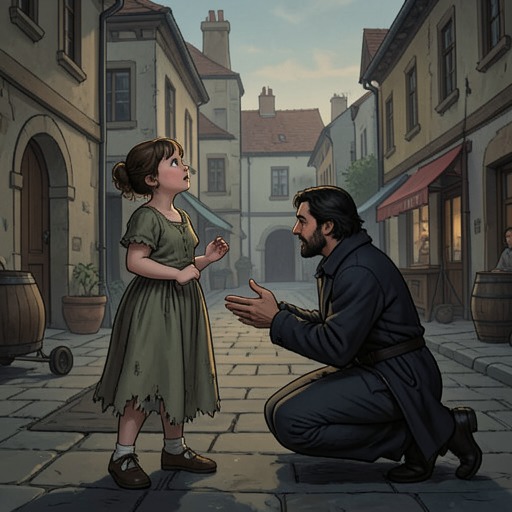
The stranger circles the farm at a walk and draws water from the well without dismounting. It is blackish; he stirs it with a tin spoon, drinks, and spits back into the bucket. Then he notices Nina sitting on the ground against what remains of the wall. She stares at him with immobile eyes; soot covers her face, her red skirt is visible, and scratches or wounds mark her body. The details of her appearance connect the buried child from the night of the attack to the burned landscape in which she is found.
Nina does not seem to have anything to say. The man studies her face and hair, offers his hand, and lifts her onto the horse behind him. The rescue is carried out without an explanation or a spoken exchange: she takes his hand and leaves the ruins with him. Fattoria di Mato Rujo thus becomes the place where Nina is hidden, left in danger, and finally discovered, while its destruction marks the break between her family home and the uncertain life that follows.